

What is the impact of water quality on an automatic commercial coffee machine?
Leave a message

If you're a café owner, office manager, or anyone running a busy commercial space, your automatic coffee machine is basically your silent workhorse. It cranks out dozens of lattes, espressos, and drip coffees a day-often under tight time pressure. But here's a thing most people sleep on: water quality is the single biggest, most underrated factor in how that machine performs, how long it lasts, and even how good your coffee tastes. As someone who's supplied automatic commercial coffee machines for years, I've seen firsthand what happens when folks ignore this. It's not just a "little white powder" problem-it can tank your profits, ruin customer experiences, and turn a $5,000 investment into a $10,000 headache in no time. Let's break this down, real talk.
First, let's start with the basics your barista might not tell you. Commercial automatic coffee machines run water through tiny, sensitive parts: heating elements, steam wands, brew chambers, and all those narrow tubes that carry water to the coffee grounds. That water isn't just H2O-it's full of minerals. The main culprits here are calcium and magnesium, usually called "hardness minerals." Think of them like tiny, sticky rocks that build up over time. If your tap water has a hardness level over, say, 100 ppm (parts per million), that's when the trouble starts. I can't count how many times a client has called me panicking because their machine won't heat up, only to pull out a brew head crusted over with chalky limescale. It's not a manufacturer defect-it's lazy water management.
Wait, but it's not just limescale that messes things up. Another big one is total dissolved solids (TDS)-stuff like chlorine, heavy metals, and organic gunk from old pipes. Chlorine, for example, doesn't do anything good for coffee flavor. It strips away the bright, fruity notes in specialty beans and leaves a weird, medicinal aftertaste. I had a client last year who kept getting complaints that their lattes tasted "off," no matter what beans they used. We tested their water, and sure enough, their tap had high chlorine. Switched them to filtered water, and suddenly their reviews went from "meh" to "best latte in the neighborhood." That's how fast water quality hits your coffee's taste.
Now let's talk about the machine itself, because that's where my role as a supplier comes in. Automatic commercial coffee machines aren't cheap-they're built to handle high volume, but they're still precision equipment. Limescale buildup doesn't just block lines; it acts like insulation on heating elements. So a heating element that's supposed to get water to 195-205°F (the sweet spot for coffee extraction) might take twice as long, or never reach the right temp. That means under-extracted, weak coffee every time. Worse, the heating element has to work harder to compensate, which shortens its lifespan. I've seen a $6,000 machine's heating element die in 18 months because the owner skipped regular descaling. A little filter and monthly checks could've added 2-3 years to its life.
But here's the thing: not all machines are created equal, and some are more forgiving if you nail water quality. For example, the JL60A Milk Steam Wand Commercial Espresso Coffee Machine-that one's designed with self-descaling tech, but it still works best with properly treated water. The steam wand, in particular, is a magnet for mineral buildup because it's exposed to hot, pressurized water and milk residue. If limescale clogs the wand's tiny holes, your milk will steam unevenly-some parts too hot, some not hot enough, leading to curdled milk and bad microfoam. No matter how good your barista is, a clogged steam wand can't make a great latte.
Volume is another factor that makes water quality non-negotiable for commercial setups. A café that pulls 50 shots a day is different from an office that cranks out 200 drinks for employees and visitors. We recently supplied a Tabletop 10 inch commercial coffee machine automatic to a downtown co-working space. They thought their tap water was fine until 6 months in-suddenly their brew chamber was so clogged, the machine would only make half a cup at a time. They'd skipped descaling for 4 months because "the machine said it was fine." Turns out, the co-working space's high daily volume meant minerals were building up twice as fast as in a small café. That's why we always walk new clients through water testing as part of the setup process-before they even unbox the machine. It's not an extra upsell; it's part of making sure their investment works long-term.

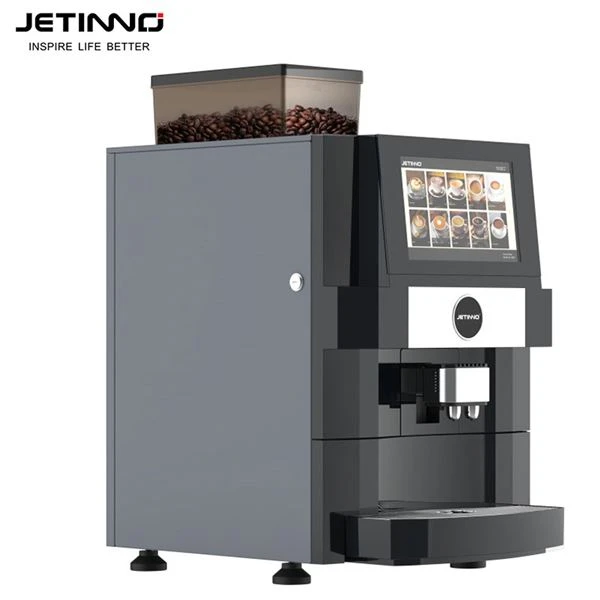
Wait, let's not forget other parts of the machine, like the hot chocolate or tea functions. If you're serving more than just coffee-say, a chocolate drink machine automatic bean to cup coffee maker or a
Fresh Tea Coffee Machine Commercial Vending Machine -- JL26-ESFB4C-P-those have their own water lines. Tea, for example, is super sensitive to water temperature and purity. Hard water makes tea taste cloudy and bitter, and mineral buildup in tea spouts will leave a chalky residue in every cup. We had a client that added tea to their menu and started getting tea complaints immediately. Testing showed their water was 180 ppm hardness-way too high for tea. Switched to a water softener, and their tea reviews improved so much, they added 10% more tea drinks to their sales. That's a direct revenue win from fixing water, not the machine.
Now, what about countertop models that are meant for smaller spaces, like a 14-inch machine for a boutique shop? The 14inch Countertop Coffee Machine For Business is compact, but it still has the same tiny, delicate lines as big industrial machines. A lot of small business owners think "it's tiny, so it doesn't need good water" - nope. A $1,500 countertop machine that dies in 2 years because of limescale is way worse value than a $3,500 machine that lasts 5 years with proper water care. We see this all the time with boutique owners who skip water filters to save a few bucks, then end up spending hundreds on repairs or a new machine way sooner than they should.
So what's the actionable stuff here? I'm not here to sell you a million water treatment products-just the basics that work. First, test your water. You can get cheap test strips online, or we can help you get a proper lab test for free when you buy a machine from us. The sweet spot is 50-100 ppm hardness and TDS under 150 ppm. Second, use a high-quality water filter designed for commercial coffee machines-your residential Brita won't cut it, trust me. Third, descale regularly. Follow the machine's schedule, but if you have hard water, do it every 2 months instead of 6. Fourth, flush lines if you're storing the machine for more than a week-stagnant water leads to more gunk buildup.
I'll be real: some clients push back at first. They say, "That's too much work," or "Why can't machines just handle bad water?" The thing is, even the best commercial machines have their limits. We build them to handle daily wear, but minerals are relentless. Think of it like your car: you don't skip oil changes because the engine is "tough." Same with your coffee machine-water care is the oil change for your equipment. Skipping it costs you money in repairs, shorter machine life, and lost customers.
Last year, I had two clients buy the same model of automatic coffee machine at the same time. Client A spent 20 minutes getting their water tested, got a filter, and followed the descale schedule. A year and a half later, their machine was still making perfect coffee, no repairs needed. Client B ignored all that-used tap water, skipped descaling, and called me when their machine was dead at 10 months. They paid $1,200 for a new heating element and still had to deal with off-tasting drinks for weeks. That's a no-brainer, right? The $50 filter and 10 minutes of testing saved Client A thousands.
At the end of the day, if you're investing in an automatic commercial coffee machine, you want it to perform every time, keep customers happy, and last as long as possible. Water quality isn't a trivial detail-it's the foundation of that. It affects taste, machine longevity, repair costs, and even your bottom line. If you're shopping for a new machine and want to make sure you've got the right setup for your water, or if you're dealing with a wonky machine that might be water-related, reach out. We can walk you through water testing, machine specs that work for your space, and set you up with the right gear to keep your coffee flowing and your machine running strong.
References:
- Specialty Coffee Association. (2020). Water Guidelines for Coffee Brewing. Retrieved from sca.coffee/standards
- Jetinno Commercial Coffee Equipment Technical Manuals. (2023). Machine Care and Water Treatment Protocols.
- World Health Organization. (2022). Hardness of Drinking Water: Health Aspects. Retrieved from who.int/water_sanitation_health/dwq/chemicals/hardness/en/
- National Coffee Association. (2021). Commercial Coffee Machine Maintenance Best Practices. Retrieved from ncausa.org/resources/maintenance


