

What is the water tank capacity of a commercial bean to cup digital coffee machine?
Leave a message

If you've ever run a small café, office break room, or even a retail space that serves high volumes of coffee, you know the frustration of a commercial bean to cup digital coffee machine dying mid-rush because its water tank ran dry. As a supplier of these machines, I get questions about water tank capacity every single day-not just from first-time buyers, but from seasoned operators who've learned the hard way that capacity isn't a one-size-fits-all number. It ties directly to how many customers you serve, how often you can service the machine, and even the type of drinks your patrons order. Let's break down what you actually need to know about this critical component, so you don't end up with a machine that either needs refills every hour or forces you to haul out unnecessary floor space for a tank that's too big.
First, let's clarify what a "commercial bean to cup digital coffee machine" is, because that's where a lot of confusion starts. Unlike a standard home machine or even a small office drip brewer, these units grind fresh whole beans, brew on demand, and often include digital interfaces for customizing drink sizes, tracking sales, and alerting you to low water or bean levels. They're built for consistent, high-quality drinks over long hours-think 8 to 12 hours a day, 5 to 6 days a week, with dozens or even hundreds of drinks served daily. That means their water tanks aren't just scaled-up versions of home tanks; they're engineered to balance performance, maintenance, and footprint.
When we're talking capacity, the first rule is: there's no universal number. A machine designed for a tiny office with 10 employees will have a way smaller tank than one for a busy food hall that serves 500 people a day. But to give you a practical baseline, let's look at the sweet spots most commercial models fall into. The average range is between 2 to 5 liters (about 0.5 to 1.3 gallons) for smaller, low-volume units, and 10 to 20 liters (2.6 to 5.3 gallons) for high-volume, high-demand models. Wait, why such a big gap? It all comes down to usage. Let's do the math: a standard 12-oz (350ml) latte uses roughly 200ml of water for the espresso shot plus 150ml for steamed milk, so total 350ml per drink. A smaller office model that serves 20 drinks a day would go through 7 liters of water in a day, so a 10-liter tank would mean you only need to refill it once every day or two. A high-volume model serving 100 drinks a day would use 35 liters, so it would need a larger tank, or-more commonly-plumbed-in water access, which we'll get to later.
Now, it's important to note that tank capacity can be misleading if you don't look at the machine's overall design. Some brands advertise total tank volume, but only part of that is usable-because the machine needs a little space at the top for the water inlet valve, and to prevent overflow. For example, a machine that says it has a 10-liter tank might only have 9 liters of usable water. That's not a trick; it's a safety feature to avoid spills when you refill or when the water level drops.
Another factor that affects capacity needs is the type of drinks your customers order. If your main sellers are black coffee or espresso shots, each drink uses less water, so you can get away with a smaller tank. If you specialize in lattes, cappuccinos, or other milk-based drinks that require more water for steaming, your water consumption goes up, so you'll want a larger tank or plumbed access. That's why, when I talk to a new café owner, the first question I ask isn't "what's your tank size?" but "how many drinks do you serve a day, and what are your top drinks?" It's way more useful than just numbers.
Let's talk about common scenarios, because that's where real-world application matters. If you're equipping a small office with 20 to 30 employees, or a boutique café that serves 50 to 80 customers a day, a compact model is probably ideal. For example, our 8L Office JL31B Fresh Milk Coffee Machine is built for these low-to-moderate volume spaces, and it has a 8-liter water tank-perfect for serving up to 60 drinks before you need to refill. It's countertop-friendly, too, so it doesn't take up a lot of space, which is a big plus for smaller break rooms or café counters. If you're in a spot with even lower demand, like a retail checkout line that only serves a few dozen customers a day, some of our entry-level bean to cup models have 5-liter tanks that work great, with no need for mid-day refills.
Now, if you're running a busier operation-like a mid-sized café, a gym, or a busy co-working space with 100+ people visiting daily-you'll need a larger tank, or you'll want to consider plumbed water access. Our Fully Automatic Coffee Vending Machine comes in high-volume models with 15-liter water tanks, which can serve up to 120 drinks before refilling. That's a game-changer because it means you only have to check the water level once or twice a day, not every few hours. For even higher demand-like a food court, large hotel lobby, or event space that serves 200+ drinks a day-plumbed access is almost always better. A built-in water line eliminates the need for a tank entirely, so you never have to worry about running out mid-rush. If you're set on a tank for these high-volume spaces, you'd be looking at 20 liters or more, though keep in mind that larger tanks mean heavier refills-10 liters of water is about 22 pounds, so a 20-liter tank is 44 pounds when full. That's not a huge deal for one refill a day, but it's something to consider for staff who'll be doing the refilling.
Wait, a lot of people ask us: why not just get the biggest tank possible to avoid refills? That's a valid question, and the answer is footprint. Commercial spaces, especially cafes, have limited counter or floor space. A 20-liter tank is bigger than an 8-liter one, so if you're in a small café where every square foot counts, the trade-off between refilling once a day vs. twice a day might be worth sacrificing a little space for a smaller tank. It's a balance of operational convenience and real estate, and that's where talking through your specific needs with a supplier makes all the difference.
Another key point that many operators overlook: the machine's digital monitoring features play a big role in managing water capacity. All of our commercial bean to cup digital coffee machines have a digital display that shows real-time water levels, sends you alerts when it's time to refill, and even tracks usage over time. That means you don't have to guess when you'll need to restock-you can plan refills around your busiest times, so you never have an idle machine because of a low water tank. For example, if you know your café gets a rush at 8 a.m., you can refill the tank at 7 a.m. using the machine's alert, instead of running out right as the line forms.
Now, let's address a common comparison: some operators wonder if a bean to cup machine is better than a traditional instant coffee vending machine, especially when it comes to water capacity. Instant drink machines like the Free Standing Vending Machine For Instant Drinks often have larger water tanks because they mix pre-made powder, so each drink uses less water, but the trade-off is the flavor quality. Bean to cup machines use fresh beans for a richer, more authentic coffee taste, and their tank sizes are optimized for that use case. The JL500I is a two-in-one machine that can do both fresh coffee and instant drinks, so it has a 12-liter water tank that works for both, making it a good middle ground if you want to offer variety without having two separate machines.
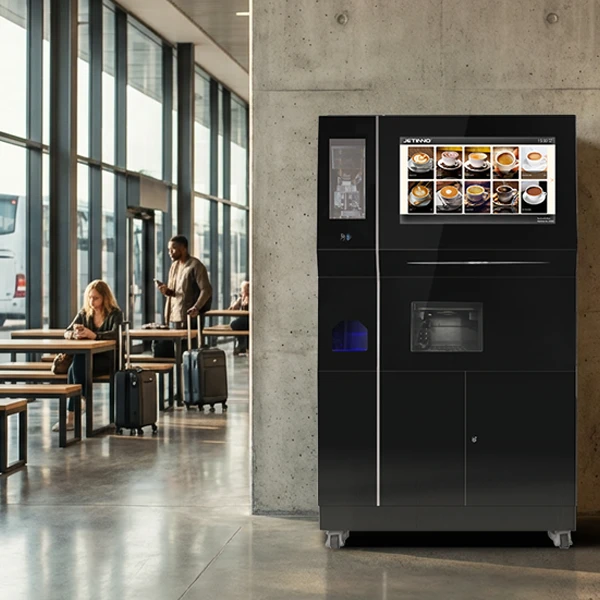

What about for even higher-volume, mixed-drink spaces? Our JL500-ESFB7CP Automatic Touch Panel Espresso Tea Coffee Vending Machine is designed for busy locations that serve a mix of coffee, tea, and even hot chocolate, and it has a 18-liter water tank to support all those drinks. It also has a digital interface that lets you program different drink sizes and water usage for each item, so you never have to worry about miscalculating how much water you'll need for a busy day.
One question we get all the time: can you plumb a commercial bean to cup machine instead of using a tank? The answer is yes, most high-end models have that capability. Plumbed access is ideal for spaces where you have a dedicated water line available-like a full café with a kitchen hookup, or a large office break room with plumbing already installed. It eliminates the need to ever refill a water tank, which means zero downtime from running out of water, and it's more hygienic because you don't have to handle refilling a tank every day (which can lead to spills or cross-contamination if not done properly). The only downside is installation-you need to hire a plumber to connect the line, which is a one-time cost, but for high-volume operations, it's almost always worth it.
Let's also talk about maintenance, because that ties directly to how well the water tank works. A larger tank doesn't mean less maintenance-you still need to clean it regularly to prevent limescale buildup, especially if your water is hard. Commercial coffee machines require descalining every 1 to 3 months, depending on water hardness, and a larger tank will hold more limescale-causing minerals, so you'll still need to clean it as often as a smaller one. All of our machines have a digital alert that tells you when it's time to descal, regardless of tank size, so you never have to guess.
Now, putting this all together, what should you look for when choosing a commercial bean to cup digital coffee machine based on water tank capacity? First, calculate your daily drink volume and top drink types to estimate your daily water usage. Second, consider your available space-if you're tight on room, a smaller countertop model like JL31B with an 8-liter tank is perfect. Third, decide if you have access to plumbing-if you do, plumbed access will give you maximum convenience for high-volume spaces. Fourth, leverage the machine's digital monitoring features to stay on top of refills, so you never have a surprise outage.
At the end of the day, the right water tank capacity isn't about getting the biggest number or the smallest-it's about matching your operational needs. Whether you're a small office owner looking for a compact machine for 20 people, a café serving hundreds of customers a day, or a retail space wanting to add fresh coffee to your offerings, we have a range of commercial bean to cup digital coffee machines with water tanks sized to fit your space and usage.
If you're ready to find the right machine for your space, reach out to our team to discuss your specific needs. We can walk you through our lineup, from the compact JL31B to our high-volume Fully Automatic Coffee Vending Machine, and help you figure out the ideal tank size or if plumbed access is right for you. Let's make sure your coffee service runs smoothly, no more mid-rush tank shortages.
References
- Specialty Coffee Association. (2022). Commercial Espresso Machine Performance Guidelines. Retrieved from specialtycoffee.org/research/commercial-equipment
- National Restaurant Association. (2023). Front-of-House Equipment Maintenance Best Practices for Coffee Service. Retrieved from restaurant.org/resources/equipment-maintenance
- Water Quality Association. (2021). Limescale Impact on Commercial Appliances. Retrieved from wqa.org/education/limescale-commercial-appliances


