
How do I adjust the brewing time of an office coffee machine?
Leave a message

If you're reading this, chances are you've stood in your office break room at 9 a.m., staring at a coffee machine that either pours a weak, watery brew that tastes like dishwater or a concentrated, bitter shot that makes your stomach churn. As someone who's spent years supplying office coffee solutions (yes, the kind you'll find here), I've heard this complaint more times than I can count. The good news? Most of the time, the fix isn't a brand new machine-it's a simple adjustment to brewing time.
Brewing time is the unsung hero of office coffee quality. It's the difference between a cup that fuels your team's morning meetings and one that has them reaching for their third energy drink before lunch. But why does it matter so much in an office setting? Unlike home machines, where one person's taste preferences shape the settings, office machines need to balance the needs of 10, 50, or even 100 different people. Some like it strong, some like it mild, and some just need a quick pick-me-up. That's where understanding how to tweak brewing time comes in.
Let's start with the basics: what exactly is brewing time, and how does it work in office machines? For context, most modern office coffee machines-whether they're the sleek, fully automatic ones or the self-service models-work by forcing hot water through ground coffee (or in some cases, instant coffee powder) at a specific pressure and for a set duration. The longer this process, the more compounds (caffeine, oils, and flavor notes) get extracted from the coffee. Too short, and you get under-extracted, sour coffee. Too long, and you get over-extracted, bitter coffee.
But here's the thing: adjusting brewing time isn't a one-size-fits-all. It depends on the type of machine you have, the coffee blend you're using, and even the size of the cup your team prefers. As a supplier of office coffee machines, I've seen firsthand how even a 10-second shift in brewing time can transform a cup from "meh" to "wow." Let's break this down step by step, so you can do it yourself without calling in a technician.
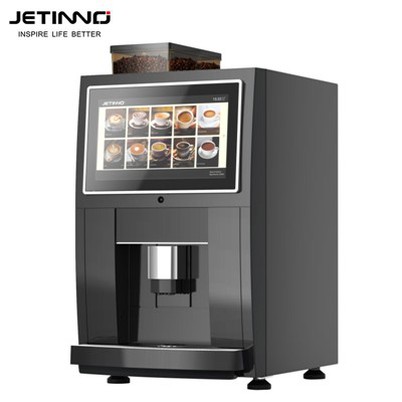
First, identify your office coffee machine type. Not all machines are created equal, and the method for adjusting brewing time varies. If you're using a fully automatic machine like theFully Automatic Espresso Cappuccino Machine Maker --Jetinno JL24-ES4C, the process is a bit different than a traditional drip machine. Fully automatic models grind fresh beans, measure the amount of coffee, control water temperature, and adjust brewing time all in one. For these, the brewing time is usually tied to the shot size-smaller shots (like a single espresso) have shorter brew times (20-30 seconds), while larger cups (like a latte) might have a longer brew time (30-40 seconds) because they need more coffee volume.
If your office uses a self-service instant coffee machine, the rules are a bit different. These machines work by mixing instant coffee powder with hot water, so "brewing time" here refers to how long the water is dispensed and how thoroughly the powder is stirred. For a [Self Service Instant Coffee Machine], the default settings are often set for a standard 8-ounce cup, but if your team prefers a stronger brew, you can increase the water dispense time slightly (by 5-10 seconds) or adjust the amount of powder added. Just be careful not to make it too strong-some instant powders can get clumpy if mixed with too much water or not enough stirring time.
Another common type is the Office instant coffee machine, which is designed specifically for high-traffic office environments. These machines usually have pre-programmed settings for different drink types-black coffee, cappuccino, latte, etc. To adjust brewing time here, you'll typically access the machine's menu (often via a button combination or a touch screen) and look for a section labeled "brew settings" or "coffee strength." Most modern office machines, like the [Instant Coffee Machine Horeca Office Use 10inch], have digital displays that make it easy to tweak these settings.
Now, let's get into the science behind the adjustment. Coffee extraction is a delicate process. The ideal extraction yield is around 18-22%-meaning 18-22% of the ground coffee's soluble compounds end up in your cup. If your brew time is too short, say 10-15 seconds, you're only extracting 12-15% of those compounds, resulting in a weak, watery cup. If it's too long (over 45 seconds for espresso, or over 3 minutes for drip), you're extracting too many bitter compounds, leading to a harsh, unpleasant taste.
So how do you measure brewing time accurately? Grab a stopwatch (your phone works fine) and time how long the machine takes to dispense a standard cup of coffee. For drip machines, this is the time from when the water starts dripping into the carafe to when it stops. For espresso machines, it's the time from when the shot starts flowing to when it stops. Once you have that baseline, you can start making small adjustments.
Let's walk through a real-world example. Suppose your office has a [Touch Screen Instant Coffee Machine], and the default black coffee setting takes 25 seconds to dispense 8 ounces. Your team complains it's too weak. First, try increasing the dispense time by 5 seconds, making it 30 seconds. Test a cup-does it taste better? If not, try another 5 seconds, but don't go over 40 seconds. Why? Beyond 40 seconds, the water starts pulling out those bitter compounds that ruin the flavor. If it's still too weak, you might need to adjust the coffee powder amount instead of time, but that's a different conversation.
Another example: if your espresso shots are taking 40 seconds and taste bitter, reduce the brew time by 5 seconds to 35. Test it again-you should notice a milder, more balanced flavor. It's all about small, incremental changes. Never adjust by more than 5-10 seconds at a time, because big changes can throw off the entire extraction process.
But wait, there are other factors that affect brew time-so you can't just adjust the timer and call it a day. The type of coffee beans or grounds matters a lot. If you switch from a coarse grind to a fine grind, the brew time will naturally increase because the water has to pass through smaller particles. Conversely, a coarser grind means shorter brew time. In an office setting, many machines use pre-ground coffee, but if you have a fully automatic machine that grinds fresh beans, the grind size is adjustable. If your team is using a blend that's darker roasted, you might need a shorter brew time because darker roasts have more bitter compounds. Lighter roasts, which are more acidic, might need a longer brew time to balance out the acidity.
Water temperature is another hidden factor. Most office machines are set to brew at 195-205°F, which is the ideal range for coffee. If the water is too cold, your brew time will be too long, and you'll get under-extracted coffee. If it's too hot, brew time will be too short, and you'll get burnt, bitter coffee. If your machine's temperature is off, adjusting brew time won't fix the problem-you'll need to calibrate the machine first, which is something we can help with as a supplier.
Cleanliness also plays a role. Over time, coffee oils and mineral buildup can clog the machine's lines, which slows down water flow and makes brew time longer than it should be. If your machine hasn't been descaled in a while, even the best brew time settings won't work. We recommend descaling office machines every 3-6 months, depending on how often they're used. As part of our office coffee machine service, we include regular cleaning and maintenance to ensure optimal performance, so if your team is struggling with consistent brew times, that might be the first step.
Now, let's talk about common mistakes people make when adjusting brewing time. The biggest one is going too far too fast. I've seen office managers bump brew time by 20 seconds, resulting in a cup that's so bitter no one can drink it. Another mistake is not testing after each adjustment. Coffee taste is subjective, so what works for one person might not work for another. That's why it's important to get feedback from your team-set up a small taste test with 2-3 different brew times and let everyone vote.
Also, don't forget about cup size. Most office machines have settings for 8-ounce, 10-ounce, and 12-ounce cups. The brew time should increase as the cup size increases, because you need more coffee and more water. If you're using a 12-ounce cup with the same brew time as an 8-ounce, you'll get a weaker cup. So always adjust the brew time when switching cup sizes.

As a supplier of office coffee solutions, I've learned that the best approach is to start with the machine's default settings, then make small tweaks based on your team's feedback. If you're using a machine like the [Office instant coffee machine], the manufacturer has already calibrated the settings for optimal extraction, so you don't need to mess with them unless there's a clear complaint. But if you do need to adjust, follow the steps I outlined: identify your machine type, measure current brew time, make 5-second increments, test, and repeat.
For offices with high traffic, consistency is key. If different people are making coffee at different times and getting different brew times, some cups will be great and some will be bad. That's why having a standardized brew time for each drink type is important. As part of our service, we provide a guide for each machine that lists the recommended brew times for different drinks, based on the coffee blend you're using. We also offer training for office staff so everyone knows how to adjust the settings correctly.
If you're still struggling after adjusting brew time, it might be time to upgrade your machine. Newer models, like the [Fully Automatic Espresso Cappuccino Machine Maker --Jetinno JL24-ES4C], have advanced features like customizable brew settings, fresh bean grinding, and automatic cleaning, which take the guesswork out of coffee making. Investing in a modern office coffee machine can save you time and money in the long run, reducing complaints and increasing employee satisfaction.
In conclusion, adjusting the brewing time of an office coffee machine doesn't have to be complicated. It's a simple, scientific process that can make a huge difference in the quality of your office's coffee. By understanding your machine type, making small incremental adjustments, and considering other factors like grind size and water temperature, you can get a cup of coffee that keeps your team happy and productive.
If you're looking for a reliable office coffee machine that's easy to adjust and maintain, we have a range of options to suit your needs-from self-service models to fully automatic machines. To discuss your office's coffee requirements and find the perfect solution, contact our team today.
References
- American Specialty Coffee Association. (2020). Specialty Coffee Extraction Standards.
- Jetinno Coffee Tech. (2023). Office Coffee Machine User Manual: Fully Automatic Models.
- Food and Agriculture Organization. (2021). Instant Coffee Preparation Guidelines for Commercial Use.
- National Coffee Association. (2022). Brewing Best Practices for Office Environments.