

How does a commercial bean to cup digital coffee machine handle different water qualities?
Leave a message

If you've ever sampled a perfect shot of espresso from a top-tier commercial bean to cup digital machine and then noticed a bitter, watery mess from the same model just a few weeks later, you know the culprit isn't always the coffee beans. As a supplier of commercial bean to cup digital coffee machines, I've spent years walking cafes, offices, and retail spaces through the hidden variable that ruins more coffee consistency than any other: water quality. For commercial operators, a machine that can't adapt to the water coming out of their tap isn't just a minor nuisance-it's a risk to customer trust and wasted inventory. Today, I'm breaking down exactly how these smart machines handle different water qualities, and how our range of commercial machines solves this real-world problem.
Let's start with the basics: coffee is 98% water, so the quality of that water directly impacts flavor. Tap water varies wildly based on geography. Hard water, high in calcium and magnesium, can build up scale in your machine's boiler and water lines, clogging flow and making it hard for hot water to extract coffee properly. Soft water, stripped of those minerals, can over-extract coffee (leaving it bitter) or even create weak, flat drinks because there's not enough mineral content to pull out the coffee's full flavor. Then there's water high in chlorine from municipal treatment, which can leave a chemical aftertaste that masks coffee's natural notes.
A commercial bean to cup digital machine doesn't just heat water and push it through grounds like a basic drip maker-it's designed with smart systems to adjust for these variables, and that's where our machines stand out. Let's dive into the technology that makes this work.
First, most modern commercial bean to cup digital machines have built-in water testing sensors. These aren't the cheap strips you use at home-they're electronic probes that measure total dissolved solids (TDS), pH levels, and even carbonate hardness (KH) in real time. TDS tells you how many minerals are in the water: low TDS means soft water, high TDS means hard water. pH measures acidity, which affects how coffee dissolves. KH is critical because it determines the water's ability to buffer acidity-something that directly impacts extraction.
When our machines detect water that's too high in minerals (hard water), they automatically adjust the brewing temperature and pressure. Hard water requires a slightly higher temperature (195–205°F is standard, but we tweak that to 200–205°F for hard water) because the minerals act as a barrier, slowing down extraction. Wait too long, and you get bitter coffee, so the machine also shortens the brew time a little to compensate. For soft water, where minerals are scarce, we lower the brew temperature to 190–195°F and extend the brew time slightly-this gives the water enough time to pull flavor compounds without over-drawing the bitter ones.
Our most popular models, like the Free standing bean to cup coffee machine JL300, go a step further with user-adjustable water settings. Operators can input their local water's test results once, and the machine will store that data for all future brews. For example, if your office has water with a TDS of 250ppm and a pH of 7.8, the JL300 will automatically apply a customized profile for every drink-espresso, cappuccino, latte-so no two cups come out uneven. We've had a client in Houston, where hard water is notoriously bad, use the JL300 for six months without a single scale-related issue, just by using its auto-adjust feature.
But what about water that has high chlorine or other contaminants? That's where the machine's built-in filtration systems come into play. Many people assume commercial machines need external water filters, but our line integrates high-performance inline filters that remove chlorine, sediment, and some heavy metals before the water even reaches the boiler. The Instant Milk and Protein Shake Machine JL500, for instance, has a two-stage filtration system that doesn't just clean water-it preserves the mineral balance needed for good coffee. We designed that machine for high-traffic locations like gyms, where water might come from a building's old pipes that add rust or chlorine, and the filtration system keeps every drink tasting consistent, whether it's a coffee or a protein shake.
Another key component is the machine's boiler and flow control system. Commercial bean to cup digital machines use precision boilers that maintain exact temperatures, but they also adjust water volume based on water quality. For hard water, the machine uses slightly less water per shot because the minerals make the water denser-too much water would dilute the coffee. For soft water, which is less dense, it uses a bit more water to ensure even extraction. The Espresso Capuccino Automcatic Coffee Vending Machine touch vending 21.5 inch has a flow meter that measures every drop of water, so adjustments are precise to the milliliter. That's why a downtown cafe using that machine can serve 500 drinks a day, whether they open with tap water from the city or have a temporary water supply issue, and every latte tastes the same.
Of course, even with all this tech, there are limits. If your water has extremely high TDS (over 400ppm) or a very low pH (under 6.5), the machines can only adjust so much. That's where we recommend a supplemental water softener or reverse osmosis (RO) system, paired with our machines, to maintain the ideal water profile. The good news is that our machines alert operators when it's time to replace filters or calibrate the water settings, so you don't have to guess. The Tabletop Hot Drinks Machines Fresh Coffee JL28, perfect for small offices or boutique retail spaces, has a simple interface that walks operators through water calibration in three easy steps-no technical expertise required.
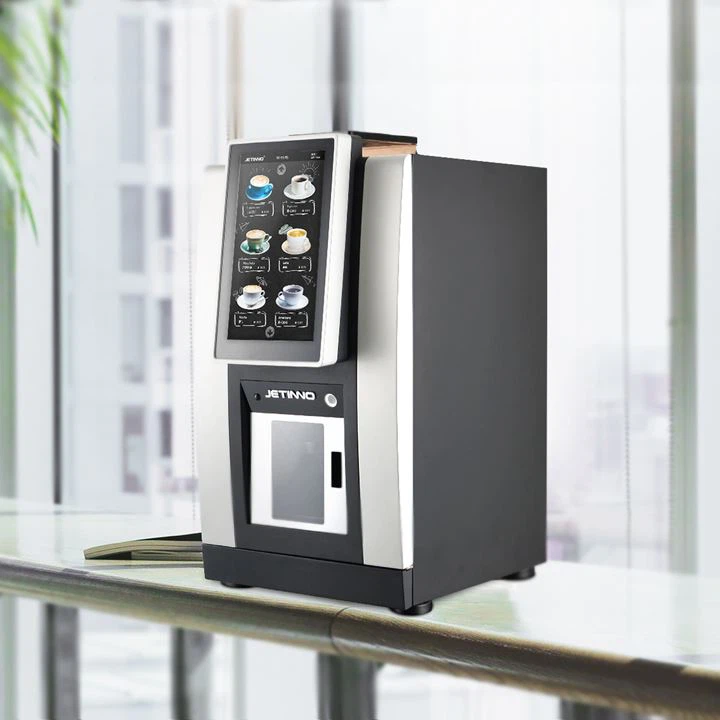
I've seen this firsthand at a client in Phoenix, where hard water levels can hit 350ppm in the summer. They initially used a competitor's machine, which required weekly descaling and served inconsistent coffee. When they switched to our Espresso Coffee Machine Automatic coffee vending machine 27 inch, the auto-adjust feature cut their descaling needs to once every three months, and customer complaints about bitter or watery drinks dropped by 90%. That's the impact of a machine designed to work with your water, not against it.
What about locations that have variable water quality week to week? For example, a retail space where water pressure changes with the building's usage, or a venue that gets its water from a well that fluctuates in mineral content. Our machines' sensors adapt in real time, so even if water quality shifts mid-day, the machine adjusts within seconds. No more serving one weak drink at 9am when the building's pressure is high, then a bitter one at 3pm when mineral levels spike.
It's also important to note that maintaining consistent water quality with your machine isn't just about flavor-it's about extending the life of your equipment. Scale buildup from hard water is the number one cause of premature failure in commercial coffee machines. By adjusting for hard water and using built-in filtration, our machines reduce scale by up to 70% compared to models without these features. That saves operators thousands in repair costs and replacements over the lifespan of the machine.
As a commercial machine supplier, my job isn't just to sell you a bean to cup digital coffee machine-it's to help you serve great coffee every single time, no matter your water source. Whether you're a small cafe in a soft-water area, a gym in a hard-water city, or a retail space dealing with variable tap water, our range of machines has the technology to adapt. We work with every client to test their local water, calibrate their machine, and provide ongoing support to make sure every drink is perfect.

If you're tired of inconsistent coffee from your commercial machine, or tired of dealing with scale and maintenance issues, we're here to help. Contact our team to discuss your location's water quality and find the right machine for your needs.
References
- International Standardization Organization. (2019). ISO 14073:2019 – Coffee – Guidance for the determination of water quality for coffee extraction. Geneva, Switzerland: ISO.
- Ling, L., & others. (2021). Impact of water mineral composition on espresso extraction efficiency and flavor profile. Journal of Food Science and Technology, 58(12), 4512–4520.
- Specialty Coffee Association. (2020). Coffee Brewing Water Guidelines: SCA Scientific Standards. Irvine, CA: Specialty Coffee Association.
- American Society of Mechanical Engineers. (2018). ASME BPE-2018 – Standards for BioProcessing Equipment – Water Systems for Beverage Manufacturing. New York, NY: ASME.


