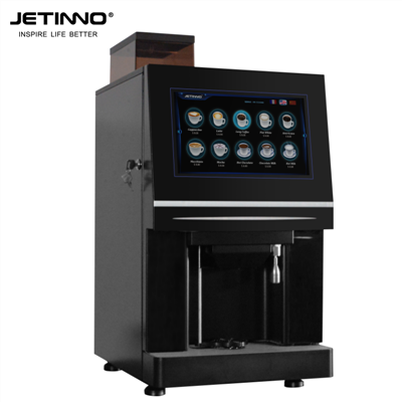

What is the weight of a commercial automatic coffee machine?
Leave a message

Hey there, if you're anyone who's ever shopped around for commercial automatic coffee machines, you've probably stumbled on a random question at some point: how much do these things actually weigh? I get it-when you're outfitting a café, office, or small foodservice spot, weight isn't just a tiny detail to jot down. It matters for fitting it on your counter, getting it delivered without a headache, or rearranging your layout later. As a commercial coffee machine supplier, I field this question at least 5 times a week, so let's break it down like I would to a new regular.
First off, let's get one thing straight: there's no one-size-fits-all number here. Commercial automatic coffee machines range from tiny countertop units that fit in a corner nook to bulkier, higher-volume models built for busy shops with lineups out the door. The weight depends on a whole bunch of factors: build materials (stainless steel adds heft vs. plastic shells), size, how many settings it has, and even internal parts like brew groups, water tanks, and bean hoppers. I've seen countertop models that hover around 30 lbs and floor-standing units that tip the scales at over 200 lbs, so it's all about what you need.

Let's start with the most popular category these days: countertop commercial automatic models. Most small to mid-sized businesses-like a 10-person office, a boutique bakery, or a corner café with limited space-opt for these because they're compact enough for standard commercial countertops. Take our 14inch Countertop Coffee Machine For Business, for example. This specific model is built to tuck into tight spots, so its weight is pretty manageable for two people to lift and set up. Let's run the numbers: it's around 45 lbs fully assembled, with a removable water tank (about 5 lbs empty) and a bean hopper (around 3 lbs empty). The stainless steel body keeps it sturdy, but since it's 14 inches wide-standard counter depth-you don't have to worry about it being too heavy to get in place. For anyone with a small space, that's a sweet spot: not too bulky, easy to move if you rearrange your shop, and durable enough for daily use.
If you need a step up in volume, but still want to keep it on the counter, our Fully Automatic Espresso Cappuccino Machine Maker --Jetinno JL24-ES4C is a solid pick. This one's built for making lattes, cappuccinos, and even hot chocolate without a lot of manual work, so it has a few more internal parts than the basic countertop model. Its weight clocks in at about 65 lbs. Why more? It has a bigger brew group for espresso shots, a built-in steam wand system that heats water faster, and a larger bean hopper (holds about 1.5 lbs of beans vs. the smaller model's 1 lb). The good news is that even at 65 lbs, two people can still handle it-just make sure your counter is rated for that weight, because even small commercial countertops can take more than you think, but it's always worth double-checking.
Now, if you're running a busier spot-like a café that gets 100+ customers a day, or a hotel lobby with a constant stream of guests-you might need something a bit more heavy-duty. That's where the coffee cappuccino chocolate making machine comes in. Wait, hear me out-this isn't just for basic coffee; it has a dedicated chocolate dispenser and can handle multiple drink sizes, so it's built for higher demand. Its weight is around 120 lbs. That makes sense: it has a larger water tank (holds 2.5 liters vs. the 14-inch model's 1.8 liters), a bigger milk frothing system, and a separate chamber for chocolate syrup. Since it's still countertop-friendly, you'll need a bit more space, but the weight is manageable if you have help getting it off the truck. I always tell customers getting this to have a buddy or two to lift it-no need to strain yourself.
Wait, let's not skip the floor-standing models, because those are super common for high-volume spots. Our Espresso Coffee Machine coffee beverage machine 14inch is actually a countertop model, but we have similar floor-standing units that are built for even more volume. If you need a machine that can crank out 50+ drinks an hour, a floor-standing unit will be heavier-usually 150 to 200 lbs. These have bigger bean hoppers (some hold up to 3 lbs of beans), dual brew groups so you can pull two espresso shots at once, and even a built-in grinder that's more powerful than countertop models. The trade-off is weight, but they're designed to stay in one spot, so you don't have to move them around much. For a full-service café or a busy office with 50+ employees, that extra weight is worth it for the speed and reliability.
Another thing I get asked a lot: does weight mean it's better? Not always. I once had a customer come to me wanting the heaviest machine on the market because he thought it would make better coffee, but he actually had a tiny counter that couldn't handle more than 50 lbs. That's where the Coffee Fresh Coffee Machine Fully Automatic --JL26-ESFB4C comes in-this is a mid-range model that's around 55 lbs, so it's sturdy but not overkill. It has a good brew system, settings for different coffee strengths, and fits on standard countertops. The key is matching weight to your needs, not just grabbing the heaviest one.
Let's talk about why this weight stuff actually matters for you, not just as a random fact. First, delivery and installation: if you're getting a machine that's over 50 lbs, you might need two people to help, or pay for white-glove delivery where they bring it in and set it up. If it's under that, you can usually handle it with a friend. Second, counter capacity: I've had customers try to cram a 100-lb machine on a counter rated for 70 lbs, and that's a no-go-you risk damaging the counter or even the machine, which is a headache. Third, future flexibility: if you think you might rearrange your shop in a year, a lighter countertop model is easier to move than a heavy floor-standing one.
I should also mention that the weights I'm giving are for fully assembled units. If you have a model that has a removable bean hopper or water tank, those parts add a few pounds, but the main body's weight is what you'll care about for lifting. For example, the 14-inch countertop model is 45 lbs fully assembled, but if you take out the bean hopper and water tank, it's closer to 37 lbs-still manageable, but the full weight is what you need to plan for when moving it.
One common mistake I see is people only looking at size and forgetting weight. A machine that's a few inches smaller might actually be heavier if it has more internal parts. That Jetinno JL24-ES4C I mentioned earlier is 15 inches wide (just an inch wider than the basic 14-inch model) but 20 lbs heavier, because it has a built-in milk frother that's more robust. So always check the specs for weight, not just dimensions.
If you're still unsure about what weight works for you, here's a quick cheat sheet I give to new customers:
- Small office (up to 10 people/day) or boutique bakery: Basic countertop model (~40-50 lbs) like our 14inch Countertop Coffee Machine For Business. This is light enough to move if needed, fits on most counters, and makes enough drinks for a small group.
- Mid-sized café or office (10-30 people/day): Mid-range countertop model (~55-70 lbs) like the Coffee Fresh Coffee Machine Fully Automatic --JL26-ESFB4C or the Fully Automatic Espresso Cappuccino Machine Maker --Jetinno JL24-ES4C. Sturdy, handles more volume, still counter-friendly.
- Busy café, hotel lobby, or office (30+ people/day): Larger countertop or small floor-standing model (~100-120 lbs) like our coffee cappuccino chocolate making machine. Built for higher demand, has extra features like chocolate dispensers or dual brew groups.
- High-volume spot (50+ drinks/hour): Floor-standing model (~150-200 lbs) – these are made for constant use, so they're heavier but built to last.
At the end of the day, the weight of a commercial automatic coffee machine is all about matching it to your specific space, volume needs, and how much you might need to move it. I've seen too many businesses make the mistake of buying a machine that's too heavy for their counter, or too light for their line, so taking a minute to think about weight can save you a lot of hassle down the line.
If you're ready to figure out exactly which model works for your space, or you still have questions about weight or features, hit me up to talk through your needs. I don't do one-size-fits-all advice, so I'll help you find a machine that fits your counter, your budget, and how many drinks you need to serve. Don't overcomplicate it-just shoot me a message and we can sort it out.
References
- Commercial Coffee Machine Weight and Installation Guidelines, National Restaurant Association, 2023
- "Countertop vs. Floor-Standing Coffee Machines: What's Right for Your Business", Foodservice Equipment Reports, 2024
- Fully Automatic Coffee Machine Build Specifications, Jetinno Technical Documentation, 2023
- Commercial Counter Weight Capacity Standards, National Kitchen and Bath Association, 2022