
What is the size of a commercial auto coffee machine?
Leave a message

If you're a business owner, office manager, or catering operations lead planning to add a coffee service for your team, clients, or guests, one of the most common (and most frustrating) questions you'll face is: What size commercial auto coffee machine do I actually need? It's not a trivial detail-choose a machine too small, and you'll face constant backups during morning rushes, lost productivity, and frustrated employees; choose one too large, and you'll waste money on unused capacity, take up unnecessary counter space, and end up with a machine that's overkill for your daily volume. As a commercial auto coffee machine supplier, I've helped dozens of businesses across industries nail the right fit, and today I'm breaking down the science, the tradeoffs, and how to measure your needs to pick a machine that works for you.
First, let's get one thing clear: commercial auto coffee machines aren't one-size-fits-all, and their size isn't just about physical dimensions on a counter. When we talk about "size" in the commercial coffee space, we're referencing two critical metrics: physical footprint (how much space the machine takes up in your workspace) and output capacity (how many drinks it can make in a given time period). Both tie directly to your daily use case, so we'll tackle each one, then walk through how to align them with your specific operation.
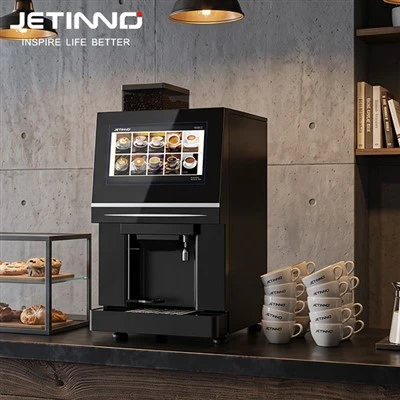
Let's start with physical footprint, because this is often the first constraint most buyers face. Office break rooms, small café counters, and restaurant back-of-house spaces all have unique layouts, and a machine that fits a downtown office might be too bulky for a boutique café. For context, a standard entry-level commercial auto coffee machine for small offices usually ranges from 12 to 18 inches in width, 20 to 24 inches in depth, and 18 to 22 inches in height. These are compact enough to sit on most standard break room counters without crowding microwaves, water coolers, or storage cabinets.
But if you're a mid-sized office or a café that sees consistent foot traffic, you'll need a larger machine, with a footprint between 20 and 28 inches wide, 24 to 30 inches deep, and 22 to 26 inches in height. These machines often have additional compartments for milk frothers, hoppers for pre-ground coffee or pods, and larger water reservoirs, which add to their size. For high-volume locations-like a busy corporate campus, a hotel lobby, or a hospital-commercial auto coffee machines can stretch up to 36 inches wide, 32 inches deep, and 30 inches tall, designed to handle heavy use without frequent restocking or maintenance.
That said, physical footprint shouldn't be a guessing game. Before you even look at machine options, measure your available counter space, accounting for clearance around the machine: most manufacturers recommend 6 inches of space behind the machine for plumbing or electrical access, 12 inches in front for catching cups, and 6 inches on either side to prevent overcrowding that could lead to spills or dropped drinks. If you're tight on space, compact models like the Office coffee machine JL18 are engineered to fit in tight break rooms while still delivering enough capacity for small to mid-sized teams. It's one of our best-selling entry models for offices with 20 to 50 employees, balancing a slim 14-inch width with a 5-pound coffee hopper and a 2.5-liter water tank to cover peak demand without taking over your counter.
Now, the more critical metric: output capacity, because a machine might fit your space, but if it can't keep up with your morning rush, it's useless. Commercial auto coffee machines are rated based on how many single-serve drinks (espressos, lattes, Americanos) they can produce per hour, a number that's tied to their boiler size, brew group design, and ability to restock water and coffee quickly. Let's break down the capacity tiers we see most often in our customer base:
- Low-volume (up to 50 drinks per hour): This is for small offices (10 to 30 employees), small home offices, or boutique co-working spaces with light foot traffic. These machines typically have a 1 to 3-liter boiler, can pull 1 to 2 shots of espresso at a time, and have a 1.5 to 2.5-pound coffee hopper. They're perfect for teams where most people make coffee outside peak hours, so you don't need to churn out drinks nonstop. For example, the JL31B we mentioned earlier falls into this tier, making it ideal for small offices that don't have more than 30 people needing coffee between 8 and 10 a.m.
- Mid-volume (50 to 150 drinks per hour): This is the sweet spot for most mid-sized offices (30 to 100 employees), retail cafes, small restaurants, or event spaces. Mid-volume machines have a 3 to 8-liter boiler, can pull 2 to 4 shots of espresso per cycle, and have 3 to 10-pound coffee hoppers, plus integrated milk systems for lattes and cappuccinos. A lot of our customers in this range choose the Powdered Milk Espresso Machine JL50, which is designed for consistent mid-volume use, with a 6-liter boiler that can keep up with 100+ drinks per hour, and a powdered milk system that cuts down on restocking time compared to fresh milk options. It's also a popular pick for offices that serve clients, since it can handle custom drinks (like vanilla lattes or cappuccinos) as well as standard Americanos and espressos.
- High-volume (150+ drinks per hour): This is for large corporate campuses, hospital cafeterias, hotel lobbies, busy chain cafes, or catering companies. These machines have 10-liter+ boilers, can pull 4 to 8 shots of espresso at once, have 10+ pound coffee hoppers, and multiple brew groups or pre-infused systems to reduce wait times. They're built for nonstop use, so they have built-in maintenance alerts, large water reservoirs (often plumbed directly to the building's water line to avoid refilling constantly), and waste drawers that can hold dozens of used coffee pods or grounds.
Wait, but how do you calculate your specific needs? It's not just about the number of employees or customers. You have to account for peak demand times. For most offices, 70% of coffee consumption happens between 8 and 10 a.m., so even if you have 100 employees, you don't need a machine that can make 100 drinks an hour-you need one that can make 70 drinks in 120 minutes, which is 35 drinks per hour. That's a key mistake a lot of new buyers make: they look at daily total consumption and multiply by 2, instead of focusing on the narrow peak window when most people will use the machine.
For example, let's say you have 60 employees, and 70% of them (42 people) get coffee between 8 and 10 a.m. That's 42 drinks in 120 minutes, so you need a machine that can make at least 21 drinks per hour. But add in that some people will get a second coffee, or a client will stop by and get a drink, and you'll want a machine that can handle 30 to 40 drinks per hour-putting you firmly in the mid-volume range, which is where models like the JL50 perform best. If you were to skimp and get a low-volume machine, you'd likely see lines form, employees complaining about waiting, or the machine breaking down from being overused.
Another factor to consider: the type of drinks your team or customers want. If your office only drinks black coffee or basic Americanos, you can get away with a smaller, less expensive machine than if you're serving lattes, cappuccinos, or custom drinks. Machines with frothers or milk systems have lower capacity per hour, because they have to heat steam to froth milk, so you'll need a higher capacity boiler to keep up. That's another reason the JL50 is a top pick for many mid-sized offices: its integrated milk system is designed to minimize downtime, so it can serve both black and milk-based drinks without slowing down during peak rushes.


We also get a lot of questions about cost vs. size, and it's important to note that a larger machine isn't always more expensive-though generally, higher capacity and larger footprint machines carry a higher upfront cost. But you have to balance that with long-term costs: a machine that's too small will lead to more frequent repairs (from being overworked), lost productivity (employees waiting in line for coffee), and even turnover for some workers who prioritize good office coffee. On the flip side, a machine that's too large will have higher energy costs (larger boilers use more electricity to heat water) and require more counter space that you might be paying rent for.
I'll also add a common misconception: commercial auto coffee machines aren't just for big offices or cafes. We've had customers in small retail spaces (10 to 15 employees) who opted for a mid-volume machine because they serve customers during the day and need to keep up with both staff and guest orders. The key is to match your machine's size to your peak, not your average, usage. If you're a small business with 15 employees and you're only serving coffee for your team, a compact low-volume machine will work perfectly-no need to invest in a larger model you'll never use.
So, how do you go about choosing the right size for your business? Let's recap the step-by-step process we walk every customer through:
- Measure your available counter space: Write down the width, depth, and height of the area you have, plus clearance around the machine for access and utilities.
- Calculate your peak coffee demand: Count how many people will use the machine during your busiest 2-hour window. Multiply that by 1.2 (to account for second drinks, guests, or unexpected use) to get your required per-hour capacity.
- Match capacity to your drink type: If you're serving mostly black coffee, you can go for a machine at the lower end of your capacity range; if you're serving milk-based drinks, add 20% to your required capacity to account for steam time.
- Compare physical footprint to your space: Filter machines by your required capacity, then check their dimensions to make sure they fit your counter. For tight spaces, compact models like the Office coffee machine JL18 are ideal for small to low-volume use, while the Powdered Milk Espresso Machine JL50 is a great mid-sized option for moderate to high-volume needs.
Of course, there are always exceptions. If you're a remote team or a small business with only a few employees, you might not need a commercial machine at all-our residential or light-commercial models work for those cases. If you're planning a temporary event or pop-up, you might opt for a portable, smaller machine that's easy to transport. But for most permanent office or commercial setups, the process above will help you avoid the common pitfalls of picking a machine that's too big or too small.
At the end of the day, the right size commercial auto coffee machine doesn't have to be guesswork. It's a balance of your physical space, your peak demand, and the types of drinks you serve. We've spent years refining our models to fit a wide range of needs, from compact office setups to high-volume hospitality locations, so whether you're a small business just starting out or a large corporation looking to upgrade your coffee service, we can help you find the perfect fit. If you're ready to discuss your space, your team size, and your coffee needs, don't hesitate to get in touch to schedule a consultation and see the options that work best for you.
References:
- National Coffee Association of the U.S. (2023). Commercial Coffee Equipment Guidelines for Office and Hospitality Settings.
- Specialty Coffee Association (2022). Capacity and Footprint Standards for Commercial Espresso Machines.
- Office Products Industry Association (2021). Break Room Space Planning for Commercial Appliances.
- Commercial Food Equipment Manufacturers Association (2023). Energy and Performance Metrics for High-Volume Coffee Machines.